Lily Baldwin

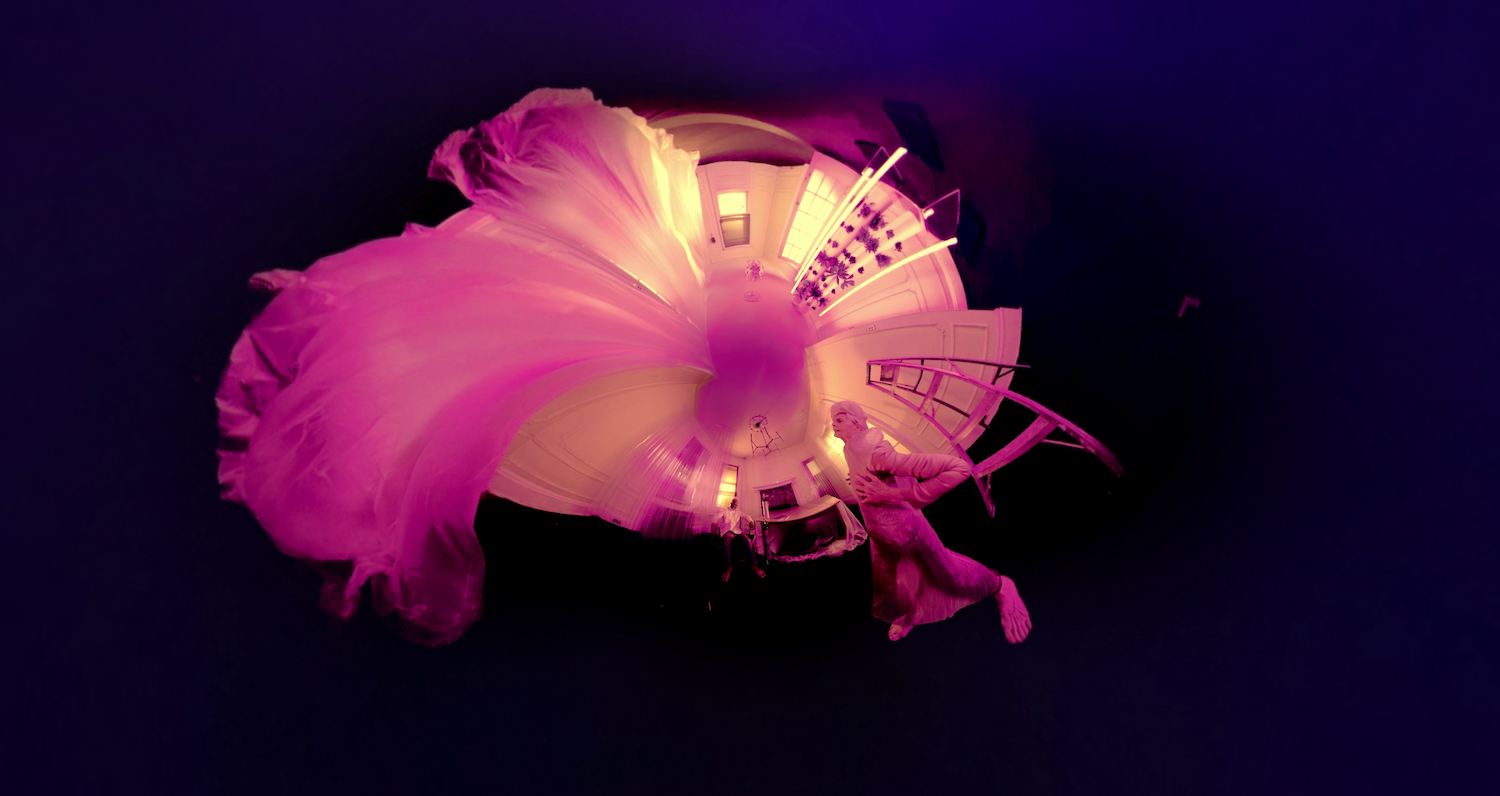


Nicolás Dumit Estévez Raful Espejo Ovalles Morel: We met through Franklin Furnace. I was immediately taken by your film work focused on dance, and in specific your latest piece: Ecstasie. Can you discuss your creative interest in the body?
Lily Baldwin: The body is my first language, and my conduit for communication between me and the world. Working as a professional dancer for many years has intensified my relationship with my own body and others’, not only as an instrument of expression, a barometer for truth, but as a vocation and a practice. I built a relationship with my body that demanded I examine the balance between control and collaboration. My body is entirely me and it is also a vehicle, a vessel for my experience. Through rigorous dance practice, my minutia and pain were transformed into portals of information. I was dancing on a world tour with David Byrne when I became aware of an electric nonverbal exchange between me and the audience, with the music as a lubricant. A new understanding came out of the power of our bodies and the intuitive capacity for storytelling. I became hooked on trying to capture this power of live performance in digital forms and harness the energetic communication through various genres and story forms. Everyone breathing can speak this language of body. And so articulate bodies-in-motion (how I define dance) are the ultimate communicators.
NDEREOM: In Ecstasie you collaborate with artist Liz Rosenfeld. I am intrigued as to the behind the scenes and the conversations that guided the two of you into the film in which you embarked together. I am of the mind that there are many layers informing any creative collaboration and that these transcend the artistic and intersect with the day-to-day of those involved. Would you be willing to say more as to your experience and I understand that you cannot talk for both parties?
LB: Throughout development and into post production there was a lot of inquiry between Liz and me into what it means to be an artist within another artist's work; Direction equates to authorship in the traditional hierarchy of power in artmaking, but what happens when this system of power is deconstructed? Should I be neutral as the director? Is that possible? How can I, as director, keep my vision for the film without altering Liz’s work? Does my “direction” of Liz make the work mine?
This was my first foray into documentary portraiture and a cornerstone of this process was ensuring Liz’s artistic sovereignty. Building trust was essential to our collaboration. Our process entailed lots of discussion and transparency.
NDEREOM: You have a dance/movement practice. You also participate in some of your films, and I mean, you are literally present and visible in them. In the case of Ecstasie, you hold conversations in front of the camera with Liz Rosenfeld, hence making the process transparent. What are you investigating through this approach? What has been revealed through this modus operandi?
LB: When I was home from Berlin editing the film in NYC, the footage felt too easy and almost lightweight in its provocative and stylized presentation. I began thinking, who am I to ask someone to disclose such intimacy while I remain hidden behind a lens? I felt almost hypocritical. So I decided to puncture the polished, performative presentation of our onset footage by integrating our BTS process into the narrative form. I wanted to serve the story and let the story dictate its needs. During one of our conversations when Liz said (I’ll paraphrase) that a director's absence could feel almost violent to them, I began to reconsider my placement in this all. I wanted to find a way to debunk the power of my invisible but pervasive eye in directing this film by revealing myself and admitting my implicit bias. I didn’t want to make the film about me. My self-disclosure is also meant to be an invocation to the viewer; to invite them into a similar self-reflection considering the power dynamics inherent in our roles as observers.
NDEREOM: In one of my emails to you I mentioned how, as I watched your films, I arrived at the realization that we might be traveling through two very different New York Cities. I have in the past understood that there are as many New Yorks as there are New Yorkers. However, through your films I was made aware of my own New York, which is pretty much Latinx, immigrant, and circumscribed to Manhattan and the South Bronx. How are connections with actors and with neighborhoods and communities forged in your case? What is the relationship that remains once the shooting, editing, and post production are over?
LB: You ask an important question, and I connect to the idea of moving through different New Yorks. That feels true to me, not only between us, but even within a single person over time. One of the reasons I’ve continued to work in New York is precisely because it refuses to resolve into a single story or community; it’s a city made of partial views, overlapping worlds, and moments of encounter.
In my own work, connections with actors and with neighborhoods tend to form slowly and very practically. They often begin through chance encounters, introductions, repeated presence, and trust built over time rather than through any single project. I try to work with people who are already rooted in the places we’re filming, and to stay attentive to how they understand their own environments and histories. Collaboration, for me, is about listening, adjustment, and letting the work be shaped by those relationships rather than imposed upon them.
As for what remains after shooting and post-production are finished: ideally, the relationship doesn’t simply end when the film does. In some cases that means ongoing friendships or future collaborations. I’m also conscious that not every relationship needs to be preserved indefinitely to be meaningful; what matters most to me is that the process itself is ethical, transparent, and attentive to power, access, and difference.
I don’t think my films capture “my” New York in any totalizing sense. They reflect where I, as a white woman, have been allowed, invited, or trusted to be at a particular moment, and they carry the limits of that perspective with them. I see those limits not as a failure, but as something to remain honest about, part of working in a city that is always larger, more complex, and more plural than any single body of work can contain.
NDEREOM: I see some commonalities in our creative work. Even when wearing the hat of the “social practice artist,” a label that does not fully define me, but that I take on from time to time because of funding reasons and what the art institution can comprehend and package as art. I have to be an active participant in the artwork I do or kindle. This is not always the case with social practice, where the binary of the artists/community can sometimes be noticeable. How did you learn to be in your films—in front of the camera—and what are the discoveries that have surfaced with this form of participation?
LB: As a dancer first, I have always felt others’ fascination with my body and what it can “do.” I’d rather have people interested in what it is saying. I do think there are pitfalls of objectification and romanticization that happen when an author is inside of their own work. In my creative genres of dance and dance films, a conventionally athletic and fit virtuosic body is most exalted. Nuance and slowness tend to be characterized as boring or unclear. I have wrestled with the pressure of meeting some of these standards for support, both social and institutional.
I have always felt a necessity to process ideas through my body, beyond just performing dance. Rather than thinking I am putting myself in the work, I think of the work coming through my body. Even if I’m writing a script, I spend time inhabiting the postures and sensibility of who’s on the page. When I began making films, I was untrained and it was all an experiment. I didn’t want to drag anyone else through my relentless trial and error process. As a native performer, I felt confident in front of the lens, and I learned to be inside the thing while watching it simultaneously, creating a fascinating split authorship. Like so many others, this artistic style came from creative problem solving. .
NDEREOM: Looking at your films makes me ponder about the personal in them. While there is a level of vulnerability in pieces like Terrain, I feel that there is a layer pertaining to those involved that remains within the private. Tell me how this works for you, meaning the personal in your work and how much is the viewer allowed to access? Together with Terrain, I am also thinking of SLEEPING WITH FRANK, where touch and skin are key elements, yet so much remains undisclosed.
LB: This private layer might come from my impulse to avoid anything too obvious. I love the feeling of mystery, how suspense ignites a kinetic response.. Perhaps this is part of the undisclosed you perceive, which I’ve never quite thought of in this way. I also prefer stories that can be interpreted in multiple ways or have double meanings. I strive to keep the audience asking questions without losing them, so I guess there is a mystique at play. In SLEEPING WITH FRANK I wanted to suggest multiple storylines within the confines of the quotidian. There’s something about making the ordinary extraordinary that feels like a proper challenge, especially when using nonverbal tools such as dance.
NDEREOM: How did you go about developing BFF and similar films? This particular piece looks at a relationship involving two female-presenting people and a young male presenting person.
LB: BFF comes from my earlier body of work when I was focusing on animating still images. I love how rhythmic editing can feel like a visceral experience, much more jarring than a fluid moving image. There’s also something potent to me about the omission of a frame — forgotten or lost moment in time — that feels provocative, and asks the viewer to fill in the gap, becoming a cocreator of sorts. This film in specific was commissioned by my friend and author Sarah Gerard for the release of her short story, BFF, so it is directly adapted from these characters. Henry, the young male presenting person in the film, is a friend who I’ve worked with in a lot of my films. He introduced me to his two friends who co-star in the film. We spent the afternoon in their house, being in each other’s presence and then staging and improvising different dynamics that I culled from Sarah’s book.
NDEREOM: How has film shifted the way in which you go about your day-to-day and how you relate to life?
LB: I don’t feel much separation between my work and my life, which is beautiful as I feel connected to my purpose everyday. And this intimate relationship can consume me — I never want to stop working! I document my life regularly without always knowing why. I source personal material in much of my work. Editing much of my own work — studying footage, exploring time and cropping compositions — has attuned me to doing this throughout my daily life. I love projecting tableaux and stage scenarios in my mind when I see a provocative “frame” or moment in my life. A film is fixed (more or less) and can be revisited. Life is the opposite: a fleeting experience that can never be relived. There is something about this dissonance that makes each one more precious.
NDEREOM: More and more, I am seeking to escape museum and gallery spaces. For me, they have begun to feel claustrophobic. You recently screened Ecstasie in Times Square. How was it? Have you made other journeys outside with your films?
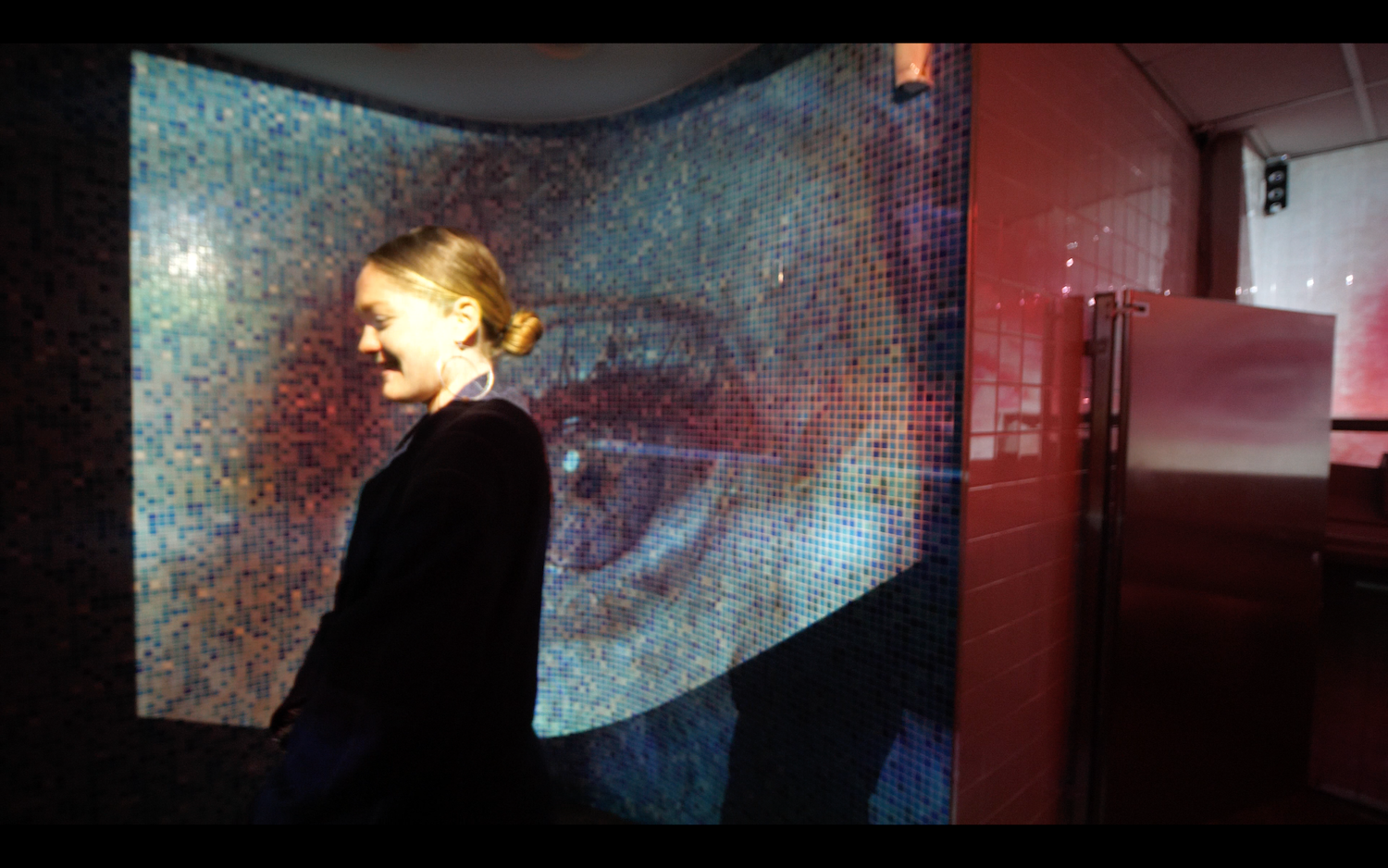
LB: It’s interesting to hear you say this, as I am more drawn to the confinement of a gallery. The limits of white walls and an enclosed environment dictate a certain kind of focused viewership which I am curious about. People go to a gallery to stand and look. The expectations and rituals are clear. We can almost predict where they might stand and therefore create for that gaze. Alternately, I have spent much of my career exploring more unknown encounters, where film and performance are unexpected and disruptive. I have created an installation in a bathroom with QUICK SLICE, in which viewers walk through multichannels projections on their way to wash hands or use the toilet. A current studio practice of mine is a project called DON’T DIE ON ME which puts verité footage of my experience with disability in conversation with footage of time spent with her father, who lives in chronic pain. I project this footage in high-trafficked NYC spaces, asking the question, who is not here? In both of these projects, unknown encounters are inherent to the premise of the work. Screening ECSTASIE in Times Square was a trip — having such and intimate conversation be surrounded by an onslaught of stimulation and hordes of people. It felt more like a project about collision and simultaneity of difference than a screening of my film.
NDEREOM: There are so many emotions surfacing as I engage your responses. There is a sense of wanting to cry, and not necessarily as a response to sadness but as an intuition that I have found a person in you with whom I can talk, be and listen. Thank you for this conversation. I hope to have the opportunity to include Ecstasie or some of your other exquisite films in any future curatorial undertaking that I organize. I know that this dialogue is a start.
LB: It has been a pleasure answering your attentive questions which have helped me deepen my relationship to my work. Thank you for carving out the inquisitive and supportive space that you do at The Interior Beauty Salon. I look forward to future overlap!
NDEREOM: Before we go, is there anything you would like to add?
LB: My newest project is a fusion of my body practice with my creative practice. THE MARROW STUDIO, is an online practice portal for movement, consciousness and creative flow. Sourcing my years as a professional dancer, with certifications in multiple forms of yoga, Pilates Mat, and Zero Balancing, and over 20 years leading private and group classes, I am synthesizing this experience into a community offering. This is an inquiry-based approach to movement, health and consciousness that values rigor, play, and presence, bridging self-care with collective change. The Marrow Studio launches March 20th and will offer a library of live and prerecorded classes and conversations with a focus on body tech and creative practice. I am so excited to share this with the community, to be in dialogue and support others who feel isolated in their artistic and body practices.
NDEREOM: I offer a big blessing to The Marrow Studio
All images courtesy of Lily Baldwin
Lily Baldwin’s related links: Website / Substack / Instagram
Lily Baldwin is a Peabody Award–nominated filmmaker, performer, and interdisciplinary artist whose work explores the ecstatic and destabilizing truths of the body. Blending fiction, documentary, choreography, and multimedia, she crafts visceral narratives centered around vilified women, disorientation, and the politics of pain.
Baldwin’s genre-defying thriller SWALLOWED was celebrated by The New York Times for its “visceral power similar to Cronenberg’s.” Her Peabody Nominated true-crime podcast, STORIES OF THE STALKED, sources her own experience with stalking to center the survivor’s voice, transmuting personal violence into shared catharsis. Recent works include ECSTASIE and TERRAIN which blend choreography, documentary, and immersive technologies into sensory rituals of transformation.
Her latest project, CHRONICLE OF HIP, is a cinematic memoir and forthcoming book that traces her lived experience with disability and illness in a society that pathologizes female pain. Using hybrid forms—documentary, installation, performance, and text—Baldwin confronts bodily truths, cultural dismissal, medicalization of the body, and the pitfalls of healthcare systems through an investigative and embodied lens.
Baldwin’s works have screened at festivals including Sundance, Venice, SXSW, and Berlinale, and exhibited at institutions such as Carnegie Hall, the Victoria and Albert Museum, MoMA Fort Worth, Criterion Collection, and Detroit Institute of the Arts. In the field of performance, she’s worked with Misty Copeland, David Byrne, Trisha Brown Dance Company, Annie-B Parson, Netta Yerushalmy, Faye Driscoll and Arto Lindsay. Baldwin has been a juror for the Tribeca Film Festival, taught and lectured at numerous universities, and is an Almanack Screenwriters and Sundance Institute fellow. Baldwin founded the nonprofit Stop Stalking Us to unite those affected by the dangerous, often invisible crime of stalking. SSU is the only non-profit in the U.S. solely dedicated to stalking.