Dió-genes Abréu
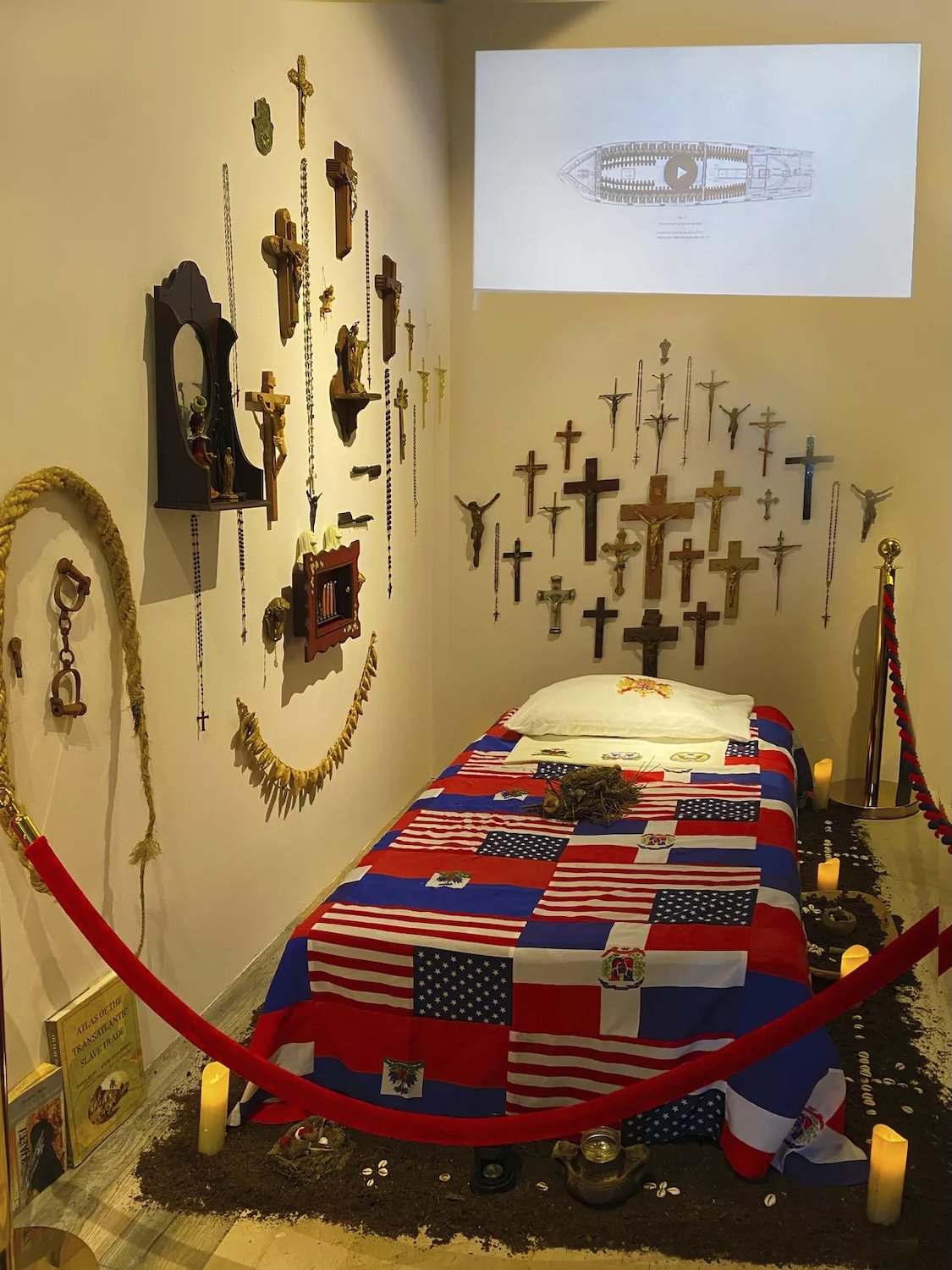
Dió-genes Abréu, Dreams and Nightmares: A Dominican Journey, 2020, mixed media / Photo: Reynold C. Kerr
Nicolás Dumit Estévez Raful Espejo Ovalles Morel: Dió-genes, we finally get to engage in this conversation. There is so much going on everywhere. I am also aware that you have been focused on editing a Dominicanyork anthology, which has been an uphill battle, given the state of subtle and not so subtle cultural censorship that can be experienced in the Dominican Republic. How are you?
Dió-genes Abréu: Machete, bro, we finally get to talk about issues we both care about! Our agendas have been crazy for many years, but here we are…now we can have a tripeo total! Yes, I was asked, by the Cultural Ministry of the Dominican Republic, to put together an anthology of essays of Dominican writers from the diaspora. Their idea was to publish a book containing works from Dominican writers who live in different parts of the United States and have a book release event during the past book fair in Santo Domingo.
One non-negotiable condition I put was that, under no circumstances, I would accept any kind of censorship of the content of the book. I had to cancel the project because they wanted to do precisely that, censor the content of the book by eliminating references to “the Haitian issue” that contradicted the official story. Many people in power in DR are prompt to censure any approach to themes related to Dominican blackness, the Haitian experience, and our prejudices on race and social status. That is why I have suffered so much censorship in DR bro! My discourse and social praxis do not coincide with their narrative.
NDEREO: You have worked for decades in Washington Heights, and have accumulated a great deal of knowledge about the place and the Dominican and Dominicanyork communities there. I lived in that neighborhood in the 1990s, somewhat briefly. The place then was perceived as dangerous to outsiders, and now the same outsiders who would not come to visit me are moving in. How are you coping with the aggressive gentrification that is taking place in Washington Heights? Part of me does not feel called to visit anymore, as most sites of reference for me are gone. I would rather remember it like it was, but maybe I am stuck in time. Tell me.
DA: Yes, gentrification has hit our neighborhood very hard, and it has displaced many people who valiantly fought against police brutality, lack of affordable housing, social services, and better schools. It seems the whole city of New York has been affected by gentrification, one neighborhood at a time. I worked as a community organizer in the hood for 37 years and it is always very difficult to organize people in poor communities because residents must confront so much in order to survive that sometimes they lack the time and energy to fight against such powerful enemies like landlords and big corporations, and political machines. Despite all that, people fought to improve the quality of life in the community and now that the area is a lot better, we are forced out by gentrification!
NDEREM: Sounds like the East Side of Austin Texas. You and I come from a locus, not necessarily physically speaking, but more in terms of consciousness, where we were taught to honor those who came before us and walked the path. In the case of Dominican visual arts in New York City, there are pillars and trailblazers like Josefina Báez, Freddy Rodríguez, Moses Ross, Chiqui Mendoza and yourself, to name a few. Then we have those who came after, like Scherezade García, Iliana Emilia García and Julio Valdez, among others. Do you have anything to say about this in regard to the U.S.-American proclivity to dismiss those who have come before and instead to start with an empty slate, which to me can be quite convenient to the systems in place?
DA: Bro, you and I know that Dominicans have left their mark on this side of the moon way before some people like to acknowledge! The historical record is there for those who tend to diminish our presence and contribution to the cultural landscape in the USA. The documenting work of the Dominican Studies Institute has helped unearth a lot of that history, as well as the work done by Dominican scholars like Frankling Guetierrez, Daisy Cocco De Filippis, and others. Take, for instance, the case of Juan Rodríguez (in Dutch: Jan Rodrigues), a mulato from what is today Dominican Republic, who was the first documented non-native to live in Manhattan in 1613. After that first tíguere dominicano landed here look at the vibrant and important Dominican community we have created on this island! Therefore, those Dominicans who are late arriving to the hood must remember that there is a rich history here before them and that ignoring it may cause their stance to seem fake and baseless. Those who know their history tend to create artworks that endure the passing of time!
NDEREM: Can you talk about the programs that you have curated throughout the years and the projects in which you have involved communities in Washington Heights? I recall Calíope and your involvement with this bookshop and cultural space in Little Quisqueya. It is too bad that organizations like this have disappeared in our Brown and Black neighborhoods. The message is that we do not read, and that is not true. You and I know how in Latin America, and in the Dominican Republic, we have had great esteem for poetry and similar cultural artforms. We also have a significant number of newspapers. Many on the island still value education and information.
DA: That is true, we come from a very poor country, but very rich culturally speaking. Of course, when we came to the USA we brought that with us. Therefore, right when I landed here for the first time in 1982, I got hooked up with a very strong cultural movement that was already here. In the epilogue of my book A pesar del naufragio I speak about that experience and the contributions it made to what we are today as a community. Nuevo Surco group, as well as Orientación, Raices Latinas, Grupo Folclórico Juan Pablo Duarte, Teatro Cuatro, among others, were already presenting theater plays and poetry readings through the Asociación de Clubes Deportivos y Culturales Dominicanos. In addition to that, we created the Colectivo de Escritores Dominicanos and the Círculo de Escritores Dominicanos, and many Dominican writers were part of those two groups and left a very important literary legacy. If anyone pretends to be a Dominican writer, knowing that history surely could help put his/her work in historical perspective. It was through that work that we arrived at the existence of Librería Moria and later Librería Calíope. Both projects were very dear to me because both served to amplify our presence and importance here as a community with more than bodegas and supermarkets to offer to the general public. Unfortunately, both projects disappeared in part because of high rents and lack of financial support for institutions so vital to the wellbeing of communities like ours.
NDEREO: I decided to curate exhibitions so that I could have a voice in the arts and support the work of creatives who I admire, as opposed to those who are part of trends that come and go. Curating for me is a collective work of art; it is an opportunity to co-create. What has called you to curate?
DA: As you well know, the fines arts are a very important component of my life. As an artist I think that I can bring something to the process of “curating” a show that someone who is not can offer when it comes to connecting with an artist’s intimate feelings about his/her work. I approach “curing” artwork detached from the commercial aspects of the work of art. For me it is more about the organic relationship between an artist’s work, its connection to sociopolitical issues, and its contributions to the advancement of aesthetic expressions, not the relevance of the artist in the art world market. I usually ask myself, how is this work plugging into or unplugging from what has already been done and why? If the work itself does not answer that question, then I must engage the artist about it. It may sound simple, but many “curators” out there think that they are even more important than the artist and that they possess God-given power to dictate what is art and what is not.
NDEREO: I think that all of your books deal with politics and that you have engaged issues of race, class and nationality with such courage. How did you become politicized and involved in social justice causes?
DA: Bro, I think I came politically spoiled right from the womb of my mother! There is no way to experience what our families have endured for decades and not have some sort of political reaction to it, if not a militant response. From very early on in my life I was exposed to all sorts of social and political activism in the most populous barrios in Santo Domingo. One book pierced my heart profoundly: Gregorio Urbano Gilbert’s Mi lucha contra el invasor yanqui del 16. After that it was book after book and solidifying my understanding of my surroundings and the sociopolitical forces shaping the future or our country. Obviously, from my social activism these views migrated to my artwork and my vision about the role of an artist in society. And here we are, bro, jodiendo la vaina todavía!
NDEREO: We are versed in Dominican and Dominicanyork cultures and ways of being. You and I have lived on the Island, abroad, and in-between. In my case, I hold no romantic notions of the place I left behind, even if I have to admit that I absolutely love the Caribbean and our birthplace. This is more of a prompt than a question.
DA: Yes, indeed, our immigrant experience has shaped our understanding of ourselves as Dominicans and Caribbeans. From DR we have a preconceived notion of what it means to be Dominican and Caribbean, but when we break away from those boundaries and are exposed to other ways of being and articulating cultural and racial identity our perceptions of who we are as a people broaden and we begin to challenge our previous notions. After that experience, every trip we take to DR becomes a very charged exposure to a more fragile sense of belonging because the country changes a lot and our memories of what we left behind don’t fit the current cartography of social and political transformation defining new cultural habitats.
Even some people from our own generation tend to feel uncomfortable and alienated when interacting with us and our new ways of perceiving and practicing our Dominicanness. I am usually accused of trying to forcefully import a snobbish point of view and theories about race and sociocultural issues. We are left with a feeling of not belonging here or there. ¡Palo si vogas y palos si no vogas!
NDEREO: I am wondering if dominicanyoridad (my neologism) is on its way out. This is a very specific way of looking at and engaging the world, even with some of its nuances. I hear most people from the younger generations referring to themselves as Dominican-Americans, and I am confused—with all respect for how anyone chooses to call themselves. I am thinking more in terms of conceding our Americanness so freaking easily to the nation who has usurped this from the rest of us in the Americas: the US. I am American by birth, even before I sat foot in the US. I am also clear that American is a colonial term and I am not interested in it. Any thoughts on that?
DA: America is a continent, not a country! It should be as simple as that, but when it becomes more important to rename the Golf of Mexico the Golf of America, instead of solving major social problems, anything is possible. Noam Chomsky spoke of “manufacturing consent” and the way many people adapt to what is dictated from above is a good example of that manufactured consent. It is not enough to decolonize ourselves; we also need to deprogram and unplug our soul from the feeding tubes of social manipulation. Antonio Gramsci insisted on calling out so called “intellectuals” who, instead of denouncing such disempowering manipulations, become complicit in it in order to protect their lifestyle.
NDEREO: I am vigilant about class issues when it comes to race, gender, sexuality, aging, identity…because class is often times overlooked in conversations about undoing these oppressive “isms”, or it is assumed that countering sexism or racism, for example, tackles class issues by default. Well, that is not so. I was wondering about your perspective on this.
DA: Classism is critical when it comes to formulating effective analyses of our surroundings and how we got to this point of our existence. Some people are afraid of talking about class and social stratification issues because those in power have done a great job at scaring us about so called “communist” ideas and perceptions. Of course, when we dig deeper into the state of affairs in our societies, we realize that class boundaries are ingrained in our social behavior, even among some people who claim to be “progressive” and from “the left.” I remember bringing this up at a meeting with community organizers in Manhattan attended by people from different backgrounds. Some attendees tried to put me off by insisting on “solidarity” and “common ground,” buy I pointed out that when the meeting would be over, some of them would go back to their townhouse apartments in Park Slope in Brooklyn and some of us will trek back to the hood in Washington Heights and the Bronx. We need to be conscious of that reality and make sure it can be discussed freely and with the seriousness it deserves.
NDEREO: Where would you say is your creative work taking you, not in terms of stepping stones, but more in terms of personal transformation?
DA: My work in general, as you well know, is very much connected to my need to explore my African cultural heritage and how it interacts and enriched my Taíno, Spaniard, and Jewish (Sephardic and Ashkenazi) heritage. Lately, I am doing a lot of research about our Haitian heritage to publish a second edition of my book Sin haitianidad no hay dominicanidad. All that journey is a personal transformation experience because the more I investigate, the more complex my notion of identity becomes.
NDEREO: What do you do to keep yourself inspired?
DA: I read a lot and connect with people and their sociocultural values. I absorb it all bro! ¡Que entren to’coño!
NDEREO: Any advice to those who will come after me and after you?
DA: Oh yes: Don’t be like us! Shape your own aspirations and build your own world based on your own reality, but do not forget that we were here also.
NDEREO: Un gran abrazo y muchas gracias for your insights.
DA: Machete bro, my pleasure to discuss these issues with you. Best of luck with all your projects and thank you for your support.
All images courtesy of Dió-genes Abréu
Dió-genes Abréu’s relatd links: Publications
About Dió-genes Abréu:
Dió-genes Abréu was born in Miches, Dominican Republic, in 1959. He completed his primary and secondary education in Santo Domingo. He has resided in the United States, in Washington Heights, Manhattan, since 1983. Abréu is a cultural worker who for many years has focused his artistic production on literature, painting, and photography. He studied visual arts at the National School of Fine Arts in Santo Domingo and at the State University of New York (SUNY), and earned a master's degree in visual arts at City College (CUNY), New York. His artistic work has been exhibited in national and international galleries and museums, including the Museum of Modern Art in the Dominican Republic, The New Museum for Contemporary Art in Soho, New York, and the Metropolitan Museum in Tokyo, Japan. In the 1990s, he taught painting and basic drawing at City College, New York; and photography at the Family Life Center of John Jay College, New York. Abréu has published four books of poetry: Poems for the Living, 1983; For Women Without Makeup, 1985; Erotiko (2024); and Territories of the Soul (2024). Some of his short stories and poems have been published in English, Japanese, and Spanish in various anthologies. In 1998, he won first prize in the 5th short story competition organized by Radio Santa María in the Dominican Republic.
Abréu was a founding member of the group Palabra: Expresión Cultural (PEC), which was dedicated to the dissemination and development of Dominican culture in the USA. The National Library of the Dominican Republic published PEC's poetry anthology, La palabra como cuerpo del delito (2001), which contains a selection of Abréu's poems in Spanish and English. In 2004, he published his book PEREJIL, el ocaso de la “hispanidad” dominicana. In 2005, he published A PESAR DEL NAUFRAGIO, violencia doméstica y el ejercicio del poder, a collection of testimonies and critical essays on domestic violence and theories of power. In 2007, he published Engañifas, discurso y práctica social. His play La Jom Atenda won the 2011 Letras de Ultramar Award in the theater category, organized by the Dominican Commissioner of Culture in the USA. In 2013, he again won the Letras de Ultramar Award with his book of essays Sin haitianidad no hay dominicanidad (2014). In 2018 and 2022, he published volumes 1 and 2, respectively, of his historical essay book A lo gringo. He is currently working on volume 3 of this work. Abréu is a founding member of the Dominican-American Visual Artists Collective, Inc. (CAVDA), founded in 2009 in New York, and of the Association of Dominican Writers in the United States (ASEDEU), founded in 2018. In 2024, he became a member of the Union of Dominican Writers, Inc. (UED).