Calling thrice
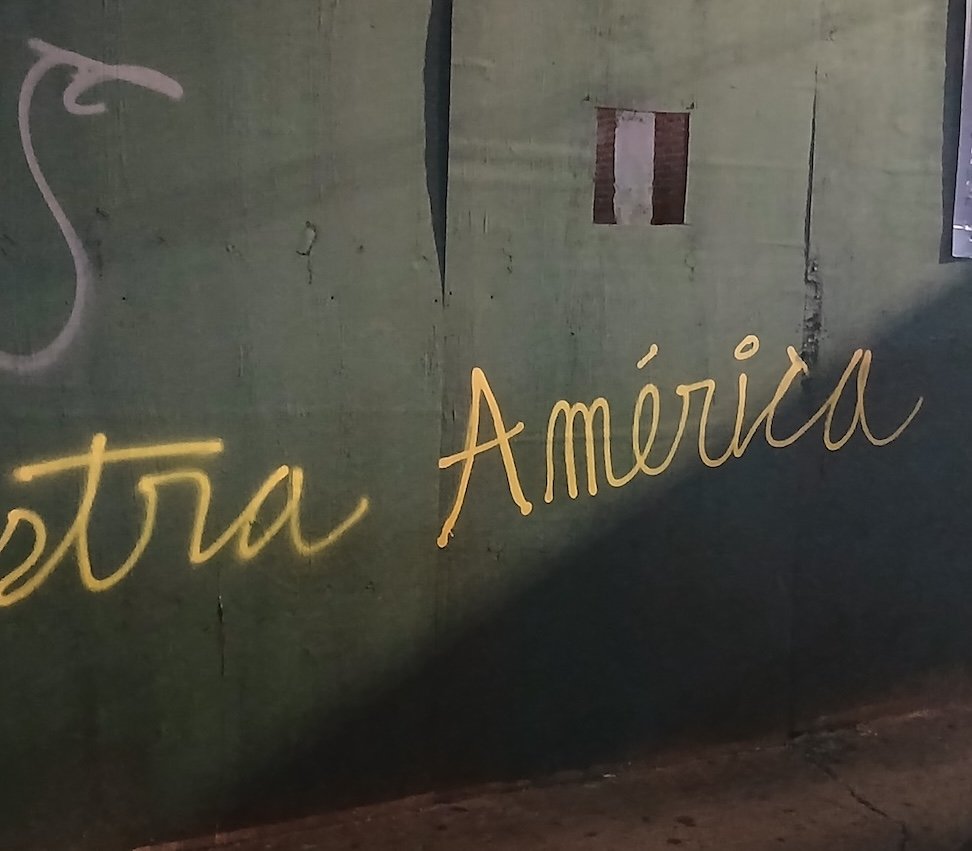
Photo: Nicolás Dumit Estévez Raful
Michel Dumit Estévez Raful
Spelling my complete middle name in an Anglo-dominated US society is in itself an act of defiance. Before moving to what many of its citizens refer to as “America,” thus appropriating the name of a whole continent for the use of a single nation, I was not familiar with the alphabet soup I would encounter there. In the US, the unstated rule goes that middle names are to be simplified by an initial, and that maternal last names are meant to be completely obviated. Economy = Productivity. The hyphenated combinations that I recall wealthy families in Latin America concocting in an effort to preserve usually non-Spanish, or simply prestige-carrying family names, tends to be done in the US to justify using a second last name. More than that, the hyphenation deployment in this country goes deeper than just last names and into the nuances of national identities and cultures, and although the hyphen before American is not always visible, to me it can be implied and felt. The gap to “Americanness” can mean that I am on my way to assimilation or on the path to belonging to the dominant system—by proxy or otherwise. Most white Europeans born here can do away with the hyphen or the gap in one single generation. That does not apply to my Brown and Black Dominican relatives who are fourth generation in the US.
To enter the non-hyphenated realm of unquestioned “Americanness,” to claim its fullness without raising any doubts, requires certain racial-cultural credentials. Take as an example my audacity in calling myself American in Bosnia and Herzegovina, that is, until a young man with whom I was sharing a taxi spoke his mind, “You do not look American.” Not at all. He was totally right if he was thinking of empire and its mechanisms to export its fair-skinned, blue-eyed and blond-haired persona across the planet. It was difficult for me to explain to this young man in Bosnia and Herzegovina, so far away from the hemisphere where I was born that, in fact, my homeplace, the island comprising the Haitian and Dominican Republics is indeed where in 1492 the whole colonial concept of Americanidad started, and from where it spread out onto a sizable portion of our planet, including the United Sates. The focus of my query in this essay is that of some of the many intricacies imbued in names and naming. It just happens that everything can use a context, a ground where to stand, sit or lie down, even queries. I also happen to be on this side of the world called América —and I remind the reader of the Latin origin of the word: Amerigo Vespucci. This was the Italian colonizer after whose name the entire hemisphere is called. I seek to connect these seemingly loose strands on naming with the Buddhist narrative of Angulimala, the “bandit” who terrorized with unwholesome deeds a region in India.
The Buddha is said to have been traversing a forest where a feared “criminal” resided, and whose name was Angulimala. The person in question had been slaughtering not only the vulnerable individuals who crossed his domains alone, but also the groups of people who sought safety in numbers. Nonetheless, the warnings about the villages that this culprit had pillaged and the devastation that he had caused did not deter the Buddha from the path he was traveling. Instead, the story mentions how the supernatural power the Buddha took on when approaching Angulimala, presented itself as an unstoppable force that left the “outlaw” trailing his victim—something unusual for someone who could chase the swiftest creatures on Earth. Strangely enough, the Buddha, who was actually walking, commanded the one running after him to stop. I find this prompt to pause a poignant tool, and I am called to bring this writing and the reading of it to a halt. For a couple of seconds.
My mother had plans for using a French and an Arabic name for me. She had secretly stockpiled Michel Dumit. I can’t explain where the Michel came from, other than Lebanon was colonized by France. I do know that Dumit was one of my mother’s uncles who emigrated from Lebanon to the Dominican Republic together with aunt Anissa and my grandfather Miguel. Still, my father Nicolás ran faster to the city office to register me as Nicolás. In Latin America it is customary for the first boy child to be named after his male progenitor, this being tacitly understood as the preservation of the man’s lineage and that of the rule of patriarchy. Yet, my mother would find her way of getting away with this, since up to this day, to her and to most, I am Dumit. Period. Change on this front would arrive slowly upon moving to the United States, where I decided to reactivate my dormant first name and bring this back to life. A ritual in honoring my deceased father, who has been relegated to the background, due to his blackness and class standing. In New York, I quickly became Nicolas D. Estevez, no accents. My Arabic name reduced to a single letter: D. My mother’s last name, Raful, gone completely. However, through the years, I have been experimenting with naming myself as an enactment of ancestral recovery. I figured that if Picasso could carry a Rosary of names, why could I not do the same: Pablo Diego José Francisco de Paula Juan Nepomuceno María de los Remedios Cipriano de la Santísima Trinidad Ruiz y Picasso. So far I am Nicolás Dumit Estévez Raful Espejo Ovalles Morel (in progress). What do Angulimala’s and the Buddha’s face-to-face in India millennia ago have to do with any of this? Calling once. Pause again, please.
The Vedic Om is linked to the very origin of the universe, and points to the first breath of creation. I am interested in this primeval image because of what I intuit as the intrinsic energy inhabiting names, and in what the act of actively calling someone can summon both at spiritual and societal levels, that is, when it comes to stoke metaphysical forces, as well as in regard to bringing about social justice. Angulimala had been named by many: murderer, a violent person, merciless, a bloodied-handed man, and a bandit. To this, he might have responded by becoming a projection mirror on which surface those meeting him could, to a great extent, see the worst nightmare of themselves—ourselves. Their naming of the other might have unconsciously spelled the narrative of the encounter and sealed their violent ending, without an option to shift the course of a common destiny. With this analysis I do not mean to discount the traumatizing realty of crime, blame the victim or absolve the perpetrator. What I am trying to do is to think from a cosmic and archetypal perspective that would allow me to access the symbolic in this narrative.
The Buddha’s courage was the counteracting response to otherwise having his fingers added to the trophy of crimes hanging from Angulimala’s neck in the shape of a necklace. The Buddha’s words carried the sound that broke the spell. In the pause the Buddha told the “criminal” to make, the bandit was immediately made anew: “Stop, monk. Stop, monk.” Calling twice. The simple action to see Angulimala in his wholeness was encapsulated in this invocation. The Buddha resorted to the power of naming to generate a major karmic shift. This disarming strategy, entailed imploding the stigmatizing epithets that had been othering the one living on the margins of town, at the center of the forest and partaking of an amoral existence. In contemporary language, the naming applies to those behind bars in a carceral system that points of new forms of enslaving entire communities, as well as those “manhandled” and handcuffed by ICE officials for the mere sin of looking, speaking, and presenting differently from the European colonial settler. The challenge is that Angulimala is always morphing, and that I find it rather far from ethical to possibly see myself in one of his incarnations, such as that of the heartless ICE official
It could be more of a myth, but I still want to tell this story. He was declared a boy at birth in the Dominican Republic. His mother in Santiago had a difficult time conceiving and had promised a rock star Catholic Virgin that, if she helped bring the pregnancy process to completion, the offspring would be named after her. I am not sure if the would-be-parent in her desperation thought of the gambling involved in this situation. Over the years, the boy developed into a fabulous woman, and since his original name was culturally understood as being female, he kept it past his/her transition. It is almost as if this name had foretold her path into the retrieval of her true self. Many of my family members who emigrated from Lebanon to the Caribbean took on Spanish sounding names. Soon my Middle Eastern relatives became José, Miguel and Pedro. Attenuated and eventually deactivated were probably their inner responses to the ancient sounds that beckoned their presences to a space. There is something in a name, in names, and naming that transcends the practical, the linear and the transactional. The Buddha knew this when recognizing the monk in Angulimala, and the naming became a mutual awakening. “Stop, monk. Stop monk.”
Calling Thrice: A practice I do in many of my seminars is for participants to call themselves three times. “Go to a safe, yet secluded space where no one could hear you. This is a place where you can shout at the top of your lungs and no one in the vicinity would be disturbed. Find the ground in whatever way works for you: through your feet, base of your spine, or back. Feel connection to gravity, to Earth. Breath in and out gently, twice. Close your eyes or gaze down. Call you name once, gently. Call your name twice, vigorously. Call your name thrice, with all of your might. Allow for the sound to travel out and far, as well as back to you and awaken the core of your being. How is it to hear you call your own name? What is your response to this call? Breath in and out with no effort. Open your eyes. Practice this when in need to search for yourself.
Calling Thrice essay and practice © Nicolás Dumit Estévez Raful
To return to Out There main menu, click HERE